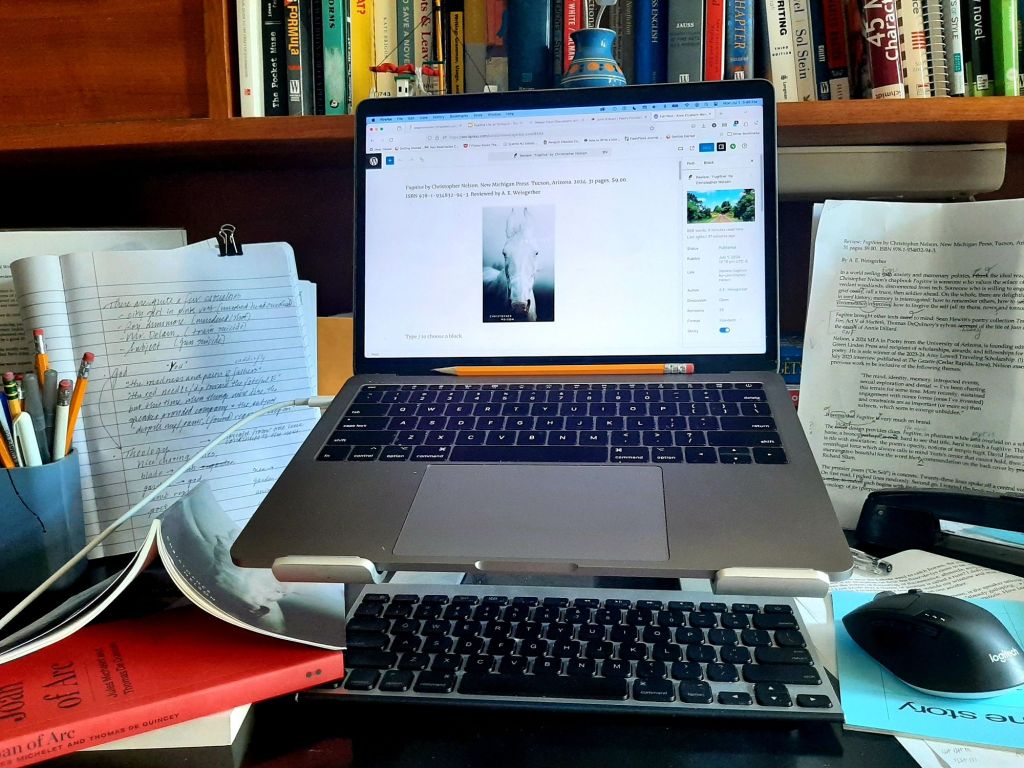
Fugitive by Christopher Nelson. New Michigan Press. Tucson, Arizona. 2024. 31 pages. $9.00. ISBN 978-1-934832-94-3. Reviewed by A. E. Weisgerber
Sometimes I feel lost in this world of screen-lit anxiety and mercenary politics, but then I remember there is poetry. I am always excited to read the New Michigan Press/DIAGRAM chapbook subscription, which I’ve purchased on and off for many years. During the time I was reading this chapbook, I had house guests and their Japanese cat for a few weeks, threw a big party, finished the school year, sold two cars and bought another, and endured a heatwave. So I would read sporadically, then chat about the work with Paul on our walks. I kept telling him about Fugitive.
If you ask me, the ideal reader for Christopher Nelson‘s chapbook is someone who values the solace of being in verdant woodlands, disconnected from tech. Someone who is willing to engage with grief coolly, call a truce, then soldier ahead. Someone who enjoys etymological exploits, and generally seeks guidance on how to shelve old memories.
Nelson, a 2011 MFA in Poetry from the University of Arizona, is founding editor of Green Linden Press and recipient of scholarships, awards, and fellowships for his poetry. He is sole winner of the 2023-24 Amy Lowell Traveling Scholarship. (!). In his July 2023 interview published at The Gazette (Cedar Rapids, Iowa), Nelson assesses his previous work to be inclusive of the following themes:
“The mind, identity, memory, introjected events, sexual exploration and denial — I’ve been charting this terrain for some time. More recently, sustained engagement with nonce forms (ones I’ve invented) and constraints are as important (or more so) than subjects, which seem to emerge unbidden.”
– Christopher Nelson
The jacket design provides clues. The word Fugitive, in phantom-white Futura, is overlaid on a white horse, a bronco? The word is rife with association: the poem’s opacity, notions of tempis fugit, David Jansson, centrifugal force which always calls to mind Yeats’s center that cannot hold, then 2) the stunning, too beautiful for the word blurb, commendation on the back cover by poet Richard Siken.
The premier poem (“On Self”) is concrete. Twenty-three lines spoke off a central void. On first read, I picked lines randomly. Second go, I rotated the book as I read the lines in order, to realize each begins with for (fortune, forthright, forty, forestalled, etc). The etymology of for (prepositions are wild) can mean “in favor of,” but at the same time means “used to indicate the direction in which someone is going.” The void central to this poem might also be an aperture.
The second concrete poem, “Union,” forms the shape of four overlapped circles, a wide-open eye. One circle concerns a diagnosis scare, a dog bite, and an ice storm; next, a car veering into a lake; third, the act of saying yes. The central ring resembles the pupil whose iris repeats: “nothing nothing nothing,” echoing the central disc of “On Self.”
Life doesn’t rhyme; it has cadence, and so do Nelson’s poems. I don’t always understand poetic form, so when I see a squarish poem of fourteen lines (“Dereliction”), okay, this may be a sonnet so there might be an argument that offers some resolution at the end, and it does indeed present a riddle and answer.
A path of flowers guides the voice: royal catchfly (“Certainty”), scarlet guara (“Melancholia”), the iris (“Blue Flags”), wild bergamot (“Fugitive”), and more. Also, shut the front door, how did I not know a cluster of peonies is called a ruin (“On Night”)? If it’s not, it should be. I’m looking at a few right outside my window and sure enough there they are chaotically collapsing and falling on one another. As the speaker of “Mind” says, “how like me to make this about me.”
The title poem is really quite astonishing. I mean, is the speaker talking about a memory a child, a horse, or a gun when saying:
I watch my son sleep in the rose night light, time already galloping away with him, a mare capable and opaque, more machine than promise. How dry its muzzle. How large the nostrils that flex and blow.
– Christopher Nelson “Fugitive”
There are quite a few elegiac poems: a “city girl,” found dead in a pink vest, a few suicides, an inevitable and tragic overdose told in reverse, and a teen named Roy Dunsmore who (I searched and the news article is yet online) was rage-murdered. A reluctant elegy for the speaker’s father is compressed into a scene:
I watch him lean toward the mirror and behold a pink sore with an attention and tenderness reserved for his prize-winning roses.
– Christopher Nelson “Cancer”
Fugitive brought other texts to mind: Sean Hewitt’s poetry collection Tongues of Fire, Act V of Macbeth, Thomas DeQuincey’s sylvan account of the life of Joan of Arc, and the essays of Annie Dillard. I reached out to the poet to ask what he reads for inspiration, and Nelson’s response was “there are certain poets I return to for inspiration and instruction—or when I need a compass.” That list includes W.S. Merwin, Carl Phillips, Dennis Hinrichsen, Jorie Graham, Paul Celan, and Li-Young Lee.
The lasting impression Fugitive makes, for me, is of a voice not only self-aware, but also savvy: symbols bridge the speaker’s earthly existence to some secular, spiritual world, like El Greco paintings. A voice therein strives toward epiphany. This is super effective when the memories of people, for the brief time they surface in the speaker’s thoughts, get spun up in notions of trees and flowers.




 Anne Elizabeth Weisgerber