So, my brother died, and I thought about it a while and didn’t know where to put it.
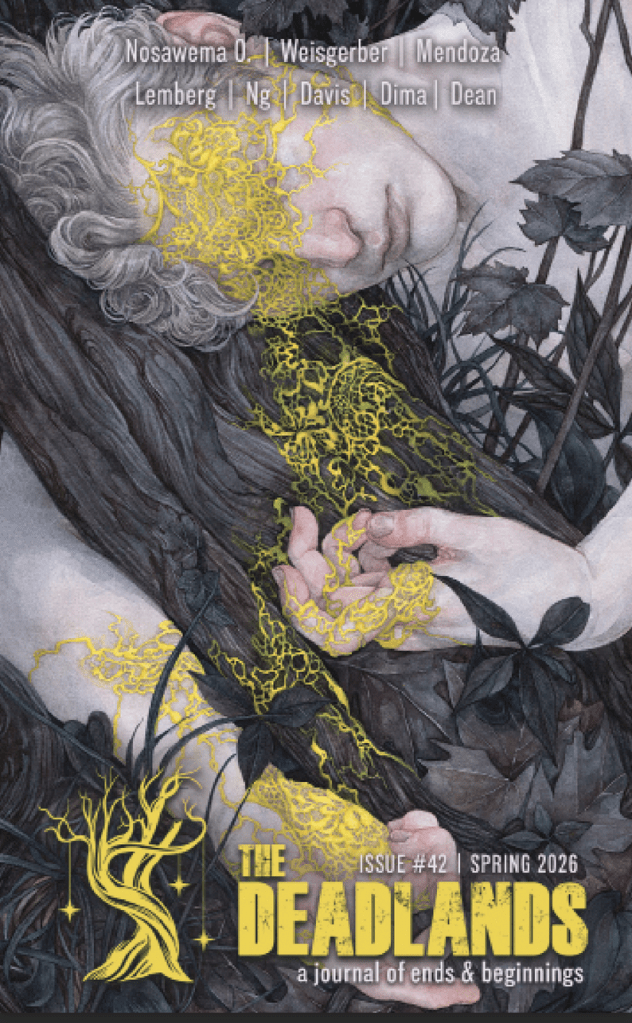
While I thought where to put it, I wrote his eulogy, his obituary, then I went to Japan, then David Lynch died, too, so I watched all his films and when I couldn’t find the film I read the script for it, and then I tried to write a story like he wrote a script, you know, controlling the eyes and ears, and then I got help writing scripts, and I frustrated a few screen writers and a few fiction writers along the way, but I’m happy to say I finally figured out where to put my brother. He’s in a story titled “In This Corner of the World,” published today in the samsara of The Deadlands.
Thank you, Editor Elise Tobler and The Deadlands editors (especially copy editor Laura Blackwell), and readers.
Touchtunes

Before today, three summers ago, I drafted a story that bombed in workshop. It had a good start: regulars at a dive bar war over the queue of songs in a digital jukebox, and it gets violent. It ends with the toughest guy of all crying in the parking lot, remembering a long-dead friend. Working title was “Bar Tap,” and, like all budding stories, it needed more shoots. There wasn’t enough heft.
The original draft was 300 words. I printed it out and put it in a manila folder.
While the story rested, I got busy with other facets of life. I would open that file and make occasional marks on it, rearrange the opening/ending, combine characters, like moving around Scrabble tiles.
Japan
I left home to visit my son in Japan the following spring, and I fell in love with all things Japanese.
I wrote thirty poems about cherry blossoms and Goya.
Not long after, I was home and listening to my favorite radio station, WFMU, and the Saturday afternoon DJ played a beautiful Japanese song that caught my ear. It was from an animated film, In This Corner of the World (2016). It’s heartbroken, “I Can’t Bear How Sad It Is”.
If you listen, I love its repetitive build, like a lullaby but underscored by strings and a meticulous, precise piano (those plucks) and an electric guitar that finally acts up. The violin nudges the singer through the lyrics, which are so forlorn. This a song, sung in Japanese, that machines can never emulate.
(The eventual finished story intimates this very song is discarded by machines through a warehouse roof.)
I have written other stories about AI misunderstanding humans, for instance “O” at the Airgonaut. As a matter of fact, some of the best things I’d ever written are on The Airgonaut’s site. My heart breaks and breaks with news of its founder and editor, the astonishing Sheldon Lee Compton, having slipped this mortal coil on 13 April 2026.
When I have more time, I plan on writing an essay on my dear Mr. Lee. He was the first editor I encountered who made me feel seen and read. My heart hurts.
David Lynch
So, I have this “Bar Tap” draft in a manila folder, a Japanese song on a loop in my brain, a free-form attitude on what fiction is, and then the film director David Lynch up and dies.
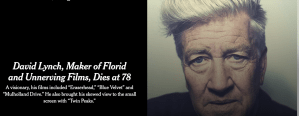
David Lynch was always very special to me. Gosh, Twin Peaks was a weekly calendar item in the late 80s. I was working corporate, buying print, and one of my fellow buyers, this great guy named Rick Hoffman, had access to tapes of each week’s episode. Like, those days, you rearranged life a little to see television programs and things. So we would talk endlessly about Twin Peaks. It was so, so different from everything. The art department loved talking about all things Lynch.
David Lynch is like Ireland. Everyone who’s been there is convinced they’ve seen the best part and they want to talk about it.
I saw Blue Velvet in the theater twice. The first time I ran late and missed the whole ‘ear’ thing and –c’est injuste– I went again. It was the 80s. Films were $4 on Tuesday nights.
David Lynch always made me feel connected to ideas he floated forth.
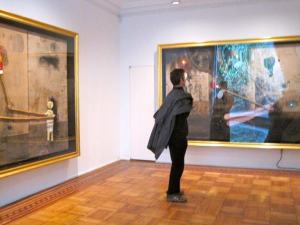
I viewed Lynch paintings in New York at Jack Tilton. Those were spaces where you could go behind a curtain and watch some art films of his on a loop. Upstairs, he remade pages from German porn art books into mixed media objects, thoughtful riffs.
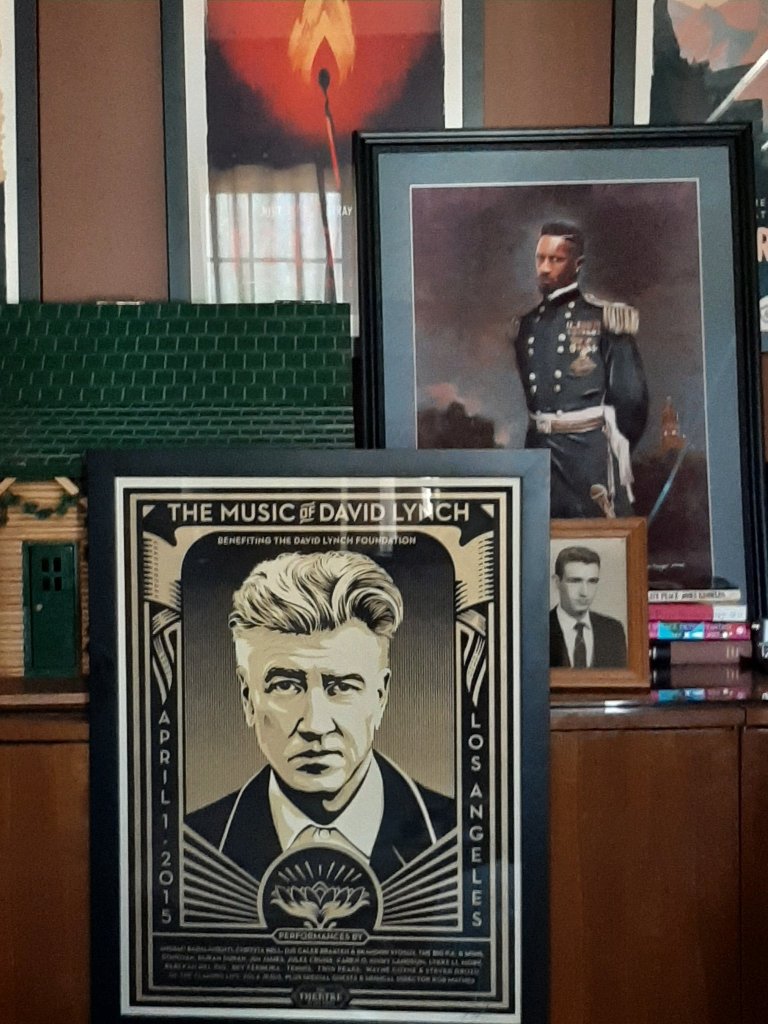
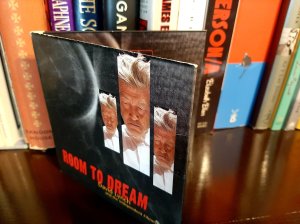
So, all the movies, the weather reports, the Mulholland Drive soundtrack, the Shepard Fairey portrait, the Room to Dream, all of it, that hair and that honking grandma voice. All of it. David Lynch gave my life great joy.
When I think back, films I love most fondly are the ones I experienced alone. Maybe that’s true of a lot of Lynch films. They are kind of a personal experience, like reading literature, or listening to opera. You’re in your own head, but in the company of the director, the author, the composer.
And then he died. Hated the news. Hate that Shel is gone. Hate that my brother is gone. I want everyone to live as long as I do. I don’t want to be left behind.
Workshops
Thinking on losses, I reached out to the fantastic editor and publisher, David Queen at Word West, just a message, because he ran a class in 2021 on the films of David Lynch. We watched a ton of films and then wrote stories and gabbed about Lynch. It was great. I just felt like saying hello to David at Word West, because I was remembering.
And it turned out Queen was mulling whether to re-run the Lynch workshop, and even though I’d done it before, I wanted to ponder Lynch again. We were going to watch all the films from Elephant Man to Inland Empire, and talk about them and workshop stories along the way. I signed up.
Problem was, once Lynch passed, a lot of his films disappeared from streaming, and weren’t really available to view easily. I mean, I have DVDs of a few but not all, and for this class we were supposed to watch a film each week before joining the weekly Zoom. But I couldn’t get access to a lot of the films in time, week-to-week.
So this is the next link in the story-draft puzzle: I began locating and reading Lynch’s scripts.
I started by poking around on Reddit, and when you are looking for specific things about someone beloved like Lynch, you might just find a link to a script, or a PDF in your inbox. That only gets you so much, though.
Most everyone knows about IMDB when it comes to film information, but I got tipped to the IMSDB — the Internet Movie SCREENPLAY Database. Not everything is there, but I was surprised by what was available.
So, to prepare for the Lynch classes at Word West (when I didn’t have access to the film), I read scripts. And what a revelation it is. I read his never-produced Ronnie Rocket. I read and was impressed by how kind literary and text-y the script for The Elephant Man was. I was amazed by how literary Mary Sweeney’s (his wife/ex/writing partner) script for The Straight Story was (yes, Lynch directed a Disney film, and it is beautiful).
I think The Straight Story is an enduring Lynch favorite for me. The script is excellent, but the film has a magic — the loving gazes, the motif of stars, the set dressing, the fact that the main actor was dying while playing a dying character? Lynch, man.
(In the main character’s living room, I’m pretty sure there are David Lynch paintings on the wall.)
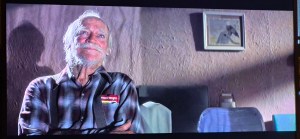
I know, I know, it’s more important to see the film than read the script. You have to hear the discordant sound effects, the electrical hissing, see his freaks and pop culture placements, appreciate the making-do-with-what’s-at-handedness of the props and costumes, the lighting, the mirroring. All of that floats my aesthetic boat.
But reading scripts was new to me. I was enchanted.
I love Lynch films. Reading the scripts gave me interesting ways of thinking about literary writing, mostly because of his insistence on forcing the eye to weird shadowy corners where there may or may not be a ghost. I saw something there.
The manila folder, the Japanese, AI, my brother, and now: Mr. Lynch has joined the donnybrook of my story draft.
By this time, it was clear to me that I liked Lynch’s storytelling style because it had a peculiar tone thanks to his mix of literary diction and oddly specific details. His scripts have a kind of stream-of-consciousness psychic sensibility. I wanted to write a story in that realm about my brother, even though he never appears in the story. Cee-Cee is trying to get him to appear. It’s kind of like that old Salinger book, wherein the most important person in the novel never actually appears in it. A lot of Lynch films explore voids.
And in the class with me were a stellar collection of fellow Lynch fans, including Elise Tobler. This is where luck blesses me. She’s a writing force of her own, and, unknown to me is editor-in-chief at The Deadlands. She was one of the first five people to read the story, “In This Corner of the World,” that now included the complications needed: the structure, the tone, the Zen, the Lynch, the POV.
(The only other time I used that floating cinematic point of view was when I described an architect’s fly-through presentation of the Broad Museum in Los Angeles, in “Sleeping Beauty, Markson Fangirl” published in 2016 at Tahoma Literary Review. I was just messing around.)
It turned out that Elise was familiar with scripts, and was interested in what I was doing.
This is a story about grief, about doggedly trying to say goodbye, and not succeeding. It’s about comfortable places we go, songs we love so much they become our very literal walk-ins, ignorant LLMs, and the ways in which we try and fail to conjure lost connections.
Further Detour into Screen Writing
Sidebar: A few months after the Lynch workshop ended, I was on my way home from work in the middle of the day, and at a corner near my house there is a Lukoil gas station with a convenience store. And that food mart was swarmed with police cars, but it was like one-each of all possible police cars: local, sheriff, county, state, unmarked feds (they had the vests), and then some other emblem that looked like the New Mexico state flag. I was rounding a corner and moving along so did not take a picture.
However, as most people do, when I got home I asked the mister what was up down the street, and he had no idea. I texted a few in-the-know neighbors and they had no idea, then I went on the socials forums to see if anyone had a clue. Nada. I checked forums that were neighbors to the Lukoil, then I clicked on some four-town page.
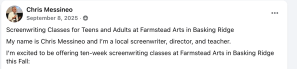
Posted only an hour before was a notice about a beginner screenwriting class happening. It was not only beginning within the week, but it was to meet in an alluring location. A revolutionary war farmhouse down a dark long shadowy road I had always been curious to investigate. I signed up immediately.
To this day, I’ll be damned if I know what happened at the Lukoil.
But I have been studying screen writing with a local legend and director, Chris Messineo. Check out the trailer for his film that is streaming now, The Strange Dark.
When I brought in pages for table-reads that follow screenwriting rules, he loved it. When I brought in pages that were filled things that were neither seen nor heard, he’d sigh: “Anne, this is not a script.” “What are you doing? What are you going for here?” And I would say I am here to figure out how scripts are formatted so I can tell stories in this framework.
God help me, I told Chris I had read David Lynch scripts and wanted to write stories like he writes movies.
I also wanted to complete my edits on “In This Corner of the World” feeling like I had a clue.
Bouncing Back into a Fiction Workshop
So while I was in this in-person screenwriting workshop with Chris on Wednesday nights, trying to write short stories like screenplays without annoying anyone too badly, I was simultaneously also work-shopping and reading fiction in an online workshop on Thursday nights, trying not to confuse anyone there with non-Shunn story formats.
I am very lucky, joyfully lucky, to study fiction sporadically with Richard Thomas. He’s so cool. Studying with Richard is something I am inclined to do when I have bandwidth.
Richard is such a kind and good human. He’s talented, generous, and moderates great conversations.
So, Richard offers this class called Advanced Creative Writing Workshop (ACWW) twice a year, maybe three? When the big three anthologies come out (BASS, BASFF, and Datlow’s BHOTY) he selects interesting things from those and class reads, then meets and discusses the curated stories, all the while workshopping original writing of our own.
I continued to explore telling complex narratives in the screen-play container. Personally, I need more on the page than a script allows. Scripts are collaborative. A lot of people get to add their vision to the core story. I don’t know if I like that, to be honest.
But I began another scripty story about things I love, this time featuring a real hero of mine, the painter El Greco and how he goes about his day in USA 2045. I love it. He likes building demolitions.
And, by the way, if you like to write and you do have the opportunity to work with the editors at The Deadlands, I say: take that elevator up.
Having The Deadlands editors interrogate the work made it stronger.
Editors Tobler and Blackwell asked very cool and insightful questions in line edits. Elise hinted at the screen formatting (which until working with Messineo I was doing in Microsoft Word. FML.)
A goal was to balance the narrative needs of fiction (POV and psychic distance/interiority of a narrator) with the technicalities of scripts and how they function.
Some editor’s notes of interest.
On my made-up word, anthropereunics:
LB: I’m not sure what this neologism is supposed to mean. Usually I see “anthropo-” for “human” (anthropology, anthropomorphic, Anthropocene). Can you tell me what the other root is?
AW: I was looking for a word that meant AI’s systemic study or scrutiny of mankind. “ereuna” = root meaning ‘to investigate, search out, inquire”
On my made-up bands and song:
LB: The (Poor Clares) exists, but I couldn’t find the song.
AW: The song title is fictional. I didn’t know a band by that name existed! (Apparently, more than one now that I’ve looked.) One had members who are by now all deceased, and then there is a religious order in Ireland that also calls themselves The Poor Clares and sings. I chose the name for the words that comprise it.
…
LB: I found a real Voxline, but not The Voxxline.
AW: Interesting. The Voxxline as a band is intended to be fictional.
On my draft’s use of the alternate/original title of an Alfred Bester novel:
LB: In the US, the title was The Stars My Destination. I’d be surprised to see a screenwriter or character use the UK title in what’s otherwise American English.
AW: Yes, that’s right — I love the Bester novel, and its original title’s allusion to Wm Blake. I’m a bit torn, because I think spirituality is freighted in on a Blake reference. At this moment, however, Cee-Cee is in awe of and mocking the AI, for its shortcomings in manifesting the dead. In the sense of Sis being a knock off, it makes sense to use the Bester ‘knock-off’ title. I like your suggestion. Let’s switch from Tiger… to The Stars My Destination, please. Thank you.
And that, my friends, is that. I hope you are able to take time to read “In This Corner of the World,” published today, 4/23/2026, at The Deadlands.
Link directly to “In This Corner of the World” here.
Thank you for visiting and reading. I write these essays because I love my stories, and this is how I say goodbye to them. x – A
C O N T A C T


